Loading...
Do not worry,
we wait with you...
49 km by road from Málaga-Costa del Sol Airport (AGP).
Torre del Mar is the main coastal town of Vélez-Málaga, in the Axarquía district east of Málaga. It is a very family-friendly beach destination, with an urban beach more than three kilometres long, a lengthy seafront promenade and, just a few minutes away, the historic heritage of Vélez-Málaga and some of the most important Phoenician sites on the Iberian Peninsula.
Explore the Costa del Sol by car
Pick up your car at Málaga Airport and explore the province at your own pace.
Car rental at Málaga AirportTorre del Mar lies on the eastern coast of the province, just over 30 km from the city of Málaga. From Málaga Airport it takes about 45 minutes along the A-7 motorway towards Almería, leaving at the Torre del Mar exit. A car is the most convenient way to get around the area and to combine the beach with trips to Vélez-Málaga, the white villages of the Axarquía or Nerja.
If you are flying in, you can pick up your rental car at Málaga Airport with Marbesol, with no deposit and all-inclusive rates, and be in Torre del Mar in less than an hour.
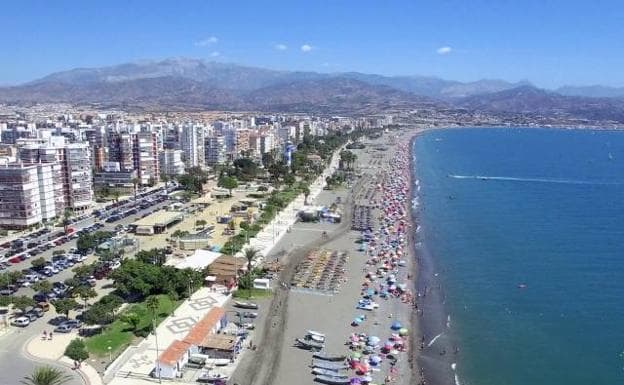
Torre del Mar beach is just over 3.3 km long and between 70 and 100 metres wide. It is divided into eight stretches: El Mortero or Canina, Laguna Chica, Faro, La Barraca or Antiguo Balneario, El Copo or Morro, Protegidas, Melosas and Río Seco. It has held a Blue Flag since 2010 as well as the Q for Tourism Quality, and offers all the facilities of an urban beach.
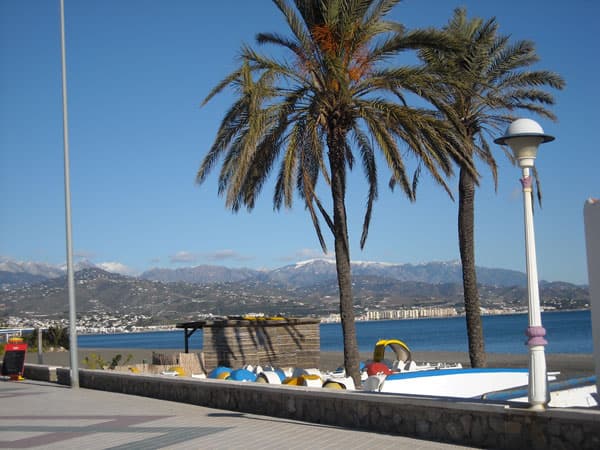
Running alongside the sand is the promenade, divided into the Paseo Marítimo de Poniente and the Paseo Marítimo de Levante, lined with chiringuitos (beach bars), terraces and places to stroll. Close by are also the beaches of La Caleta de Vélez, with its fishing harbour and marina, and Benajarafe.
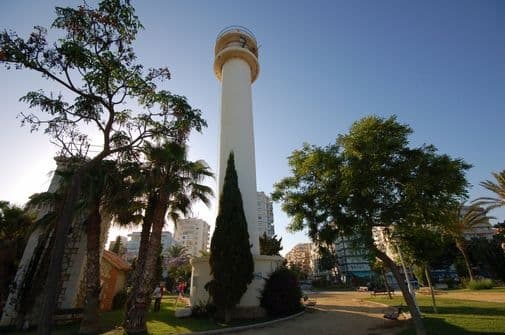
The lighthouse. Torre del Mar’s first lighthouse was built in 1864 near the mouth of the river Algarrobo, but a storm destroyed it in 1880. The current one, a 26-metre cylindrical tower beside the promenade, has been in service since 1976 and can only be seen from the outside.
The old sugar factory. Sugar cane shaped the history of the Axarquía. The Larios family acquired the Torre del Mar factory in 1852 and named it Nuestra Señora del Carmen; its last harvest season was in 1991. Today the building, with its chimneys, is a cultural centre with an exhibition on the archaeological excavations in the area.
The Phoenician sites. At the mouth of the river Vélez, in Almayate, lie the sites of Toscanos, Cerro del Peñón and Cerro Alarcón, dating from the 8th century BC. They were studied for decades by the German Archaeological Institute and have been listed as a Bien de Interés Cultural (Site of Cultural Interest) since 2008. In summer the town council runs guided tours departing from the old sugar factory.
A few kilometres inland is Vélez-Málaga, the capital of the Axarquía, whose historic centre is well worth a visit:
The main festival is that of the Virgen del Carmen, who in Torre del Mar is carried in a procession by sea and land on 26 July, in the middle of the Feria de Santiago y Santa Ana. It has been declared a Festival of Tourist Interest of Andalusia since 2021. The night of San Juan, from 23 to 24 June, is also celebrated on the beach.
The mouth of the river Vélez was one of the first places on the Iberian Peninsula where the Phoenicians settled, in the 8th century BC. In Roman times the city of Maenoba stood in the area, and the name Torre del Mar (“tower of the sea”) comes from the watchtower that guarded the coast during the Al-Andalus period. Vélez-Málaga was conquered by Ferdinand the Catholic in 1487, and in August 1704, during the War of the Spanish Succession, the naval Battle of Vélez-Málaga was fought off this coast between the Franco-Spanish fleet and the Anglo-Dutch fleet, just a few weeks after the capture of Gibraltar.
At the chiringuitos along the promenade you can eat fresh fish and espetos (sardine skewers). The Axarquía is raisin country: its traditional growing system was recognised by the FAO in 2017 as a Globally Important Agricultural Heritage System, the first in Europe. The Vélez valley is also one of the leading producers of avocados and mangoes.
